
Polyalphabetic Ciphers.
We call all substitution ciphers that use more than one alphabet for substitution a polyalphabetic cipher. Basically, as with homophone tables, the goal is to eliminate the frequency pattern of the original alphabet. Unlike simple substitution ciphers, we have several alphabets that we will use to encrypt or decrypt. In this type of cipher, a table is usually used in which the alphabets are arranged for encryption, using a keyword to determine the order in which the different alphabets are used.
Trithemius' Table.
Abbot Trithemius was the first to describe a polyalphabetic cipher using a table, which he called a tabula recta. The table used by Trithemius had the previous alphabet shifted one position in each row. To encrypt, he simply encrypted each letter with the alphabet that corresponded to the letter's position modulo n, where n is the number of letters in the alphabet. The table would look like the following using the letters of the Spanish alphabet:
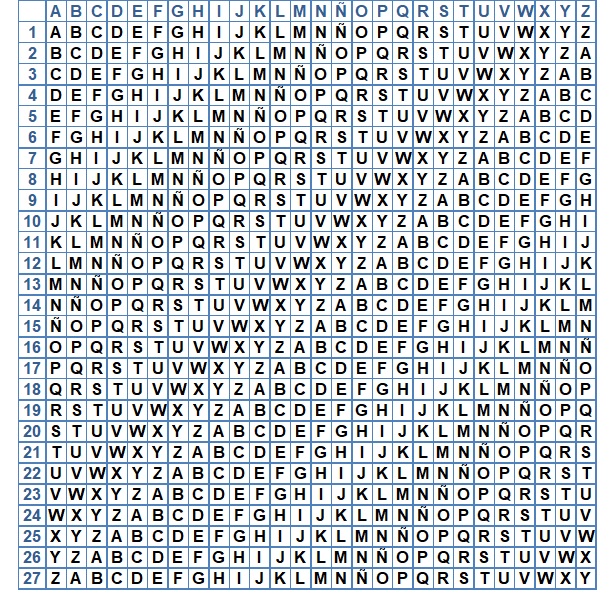
To make things easier, we've added a column on the left indicating the alphabet number. In this case, the word CIEN would be encrypted as: CJGP.
Porta's Reciprocal Table.
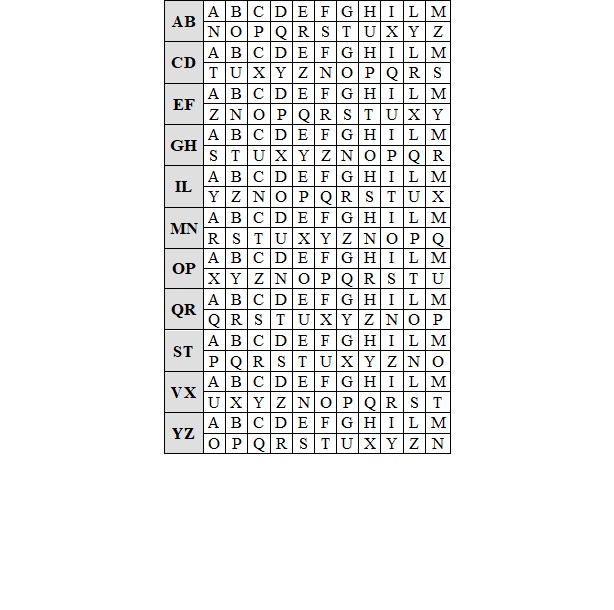
Giovanni Battista Della Porta was a quintessential Renaissance scholar. Knowledgeable in several disciplines, he bequeathed to the world of cryptography one of the first polyalphabetic cipher methods. It consisted of a table with 22 rows, each pair containing a reversible half-alphabetic. The table would look like this:
The Unbreakable Vigenère Cipher.
Without a doubt, the most famous polyalphabetic cipher is that of Blaise de Vigenère, which he called "the unbreakable cipher." The truth is that in the 17th century, Spanish cryptanalysts did not consider it a secure method, and thus, they clearly knew how to break it. However, the success in breaking it is attributed to two famous 19th-century figures: Charles Babbage and Friedrich Kasiski. The method of encryption is very simple. We use a table like Trithemius's and a word or phrase that serves as the key, as long as possible, which is repeated. The intersection of the plaintext letter with the key would give us the ciphertext letter. For example, in the following table, we see that the letter M with the key C would give us the letter Ñ.
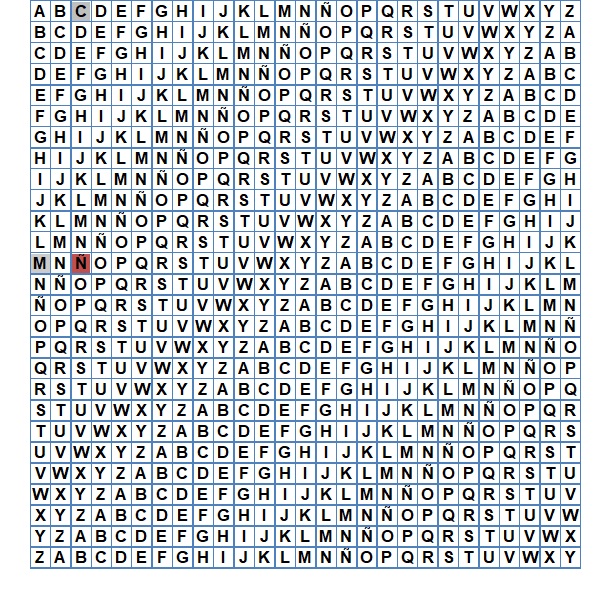
In this example, we will encrypt the word ATAQUE using the key CIEN. First, we write the word to be encrypted, and then the key, repeating it as many times as necessary. Next, we encrypt each pair, using the first row for the key and the first column for the plaintext. The encrypted message will look like this:
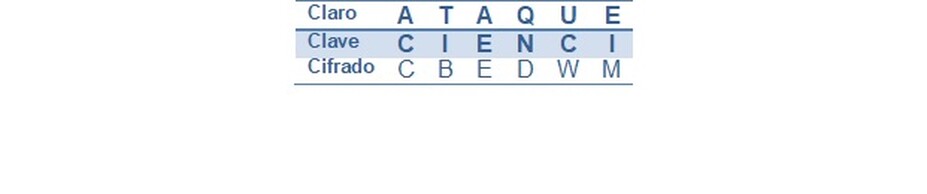
Basically, what is done is to use a simple substitution cipher chosen using the numerical order of the key, that is, the position in the alphabet of the key letter used. In the previous example, the alphabets used would be the 3rd, 9th, 5th, 14th, 3rd, and 9th respectively. If we use a table like the one above, we can simply encrypt using that number. That is, the ciphertext letter would be the plaintext letter advanced by the number of positions indicated by the key minus 1.
Mathematically, if c is the ciphertext letter, m is the position of the plaintext letter in the alphabet, p is the position of the key letter, n is the number of elements, and f is the function that gives us the letter in the alphabet at that position, we have c = f(m + (p - 1) mod n). Put another way, the formula that governs the ciphertext is the following:

The key  is the set of all the shifts of the key characters with respect to the basic alphabet. Decryption is given by the formula:
is the set of all the shifts of the key characters with respect to the basic alphabet. Decryption is given by the formula:
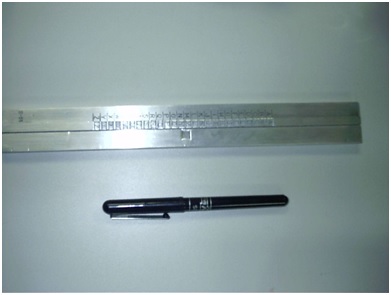
We have used ordered alphabets shifted one position, which is how the Vigenère cipher is usually used, but nothing prevents us from using random alphabets also placed in random positions, although in this case the previous formula would not be valid. To speed up encryption in the 19th and 20th centuries, a Saint-Cyr rule was often used, as shown in the following image:
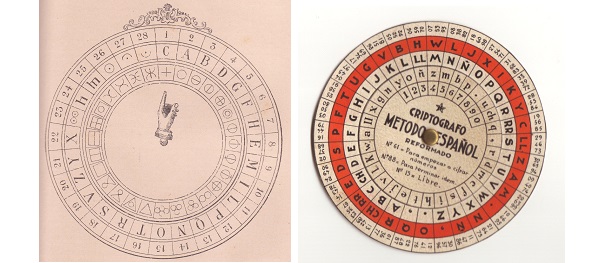
Another method, already used in the 16th century, was to use concentric discs like the following:
Variations of the Method.
Beaufort Cipher
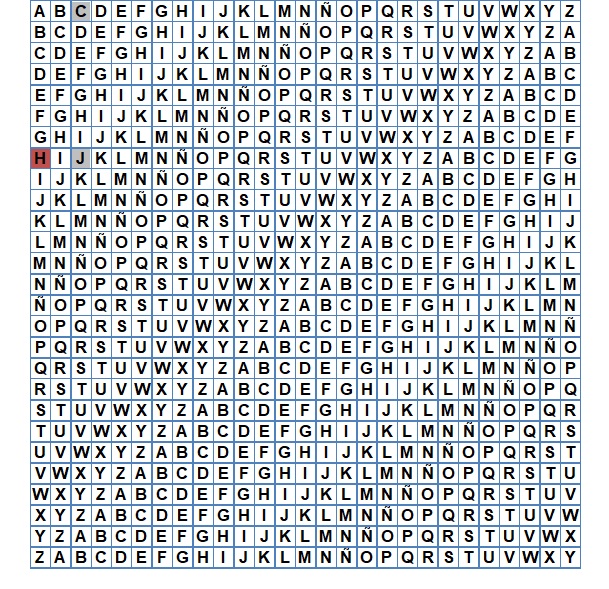
There are a couple of variations of this method that have become famous; the best known is that of the British admiral Sir Francis Beaufort, although it appears to have been invented by Jean Sestri in 1710. It basically consists of reversing the substitution process. That is, the pair (message, key) is prepared as in the previous case. The encryption is performed by finding the letter of the plaintext message in the top row. Then, the corresponding letter of the key is found in the column that this letter points to. The ciphertext character is the identifier of the row found. For example, the letter C with the key J will be encrypted with the letter H, as shown in the following table:
Mathematically, the formula that governs encryption is as follows:

The key  is the set of all the shifts of the key characters with respect to the basic alphabet. Decryption is given by the formula:
is the set of all the shifts of the key characters with respect to the basic alphabet. Decryption is given by the formula:
Gronsfeld cipher.
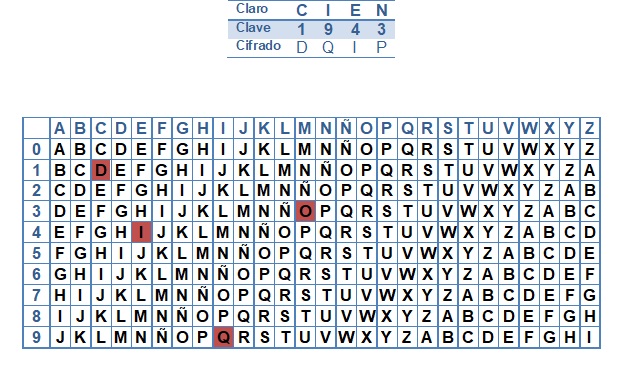
It is simply a variant of the Vigenère cipher that uses a numeric key and only has 10 rows for encryption. Graphically, it would look like the following:
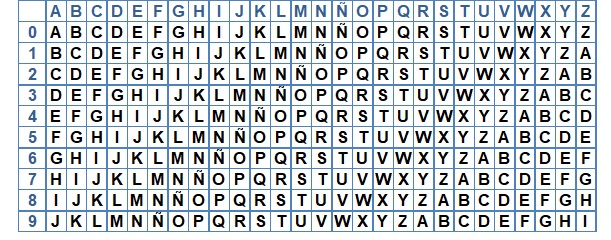
To encrypt, we choose a numeric key and shift the letter as many positions as indicated by the corresponding digit. For example, the word CIEN with the key 1943 would be encrypted as: