

Homophone tables.
This term refers to systems in which a single symbol or letter is replaced by more than one ciphertext symbol—that is, a one-to-many relationship. The primary goal is to eliminate the frequency pattern of the original alphabet. As with simple substitution systems, two alphabets are used for encryption and decryption. The fundamental difference is that these ciphers typically employ a table where a single element may correspond to multiple symbol groups in the ciphertext. It should be noted that, while the ciphertext alphabet is generally multilateral, this is not strictly required; particularly in 16th-century tables, one may encounter various unusual or cabalistic symbols used to represent a single letter.
The following is an example of what a homophone table might look like:

However, the most typical way to present a homophone table—simply because it facilitates the tasks of enciphering and deciphering—is by using a table with several rows (usually nine or ten), where the row number indicates the homophones that begin with that digit. Certain numbers can also be reserved to represent periods, word breaks, or switches between letters and numbers (or vice versa). Additionally, in some cases, a small code for frequently used words might be included. An example follows:
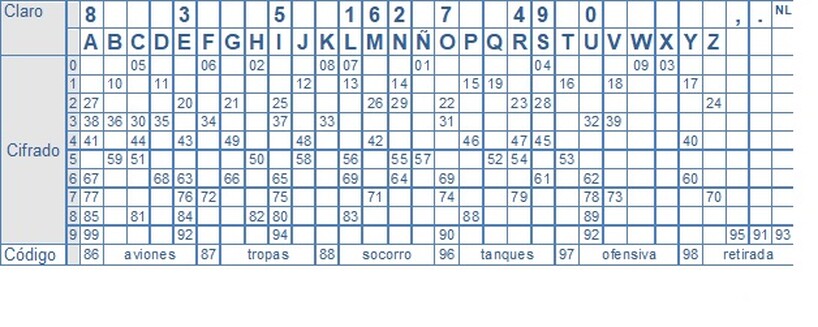
In this case, the word CIEN could be transmitted in various ways—such as 30652014, 05807655, etc.
It is a relatively secure system if traffic volume is low. Like other substitution ciphers, it is vulnerable to a probable-word attack.
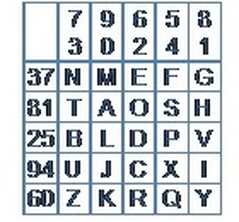
Another method for generating a homophone table is to use a Polybius square in which each row and column is represented by two numbers or two letters. The only limitation when using numbers is that the grid must be 5x5; expanding the table would result in rows or columns with only a single representation—though one could work around this by having multiple representations for columns when rows have only one, and vice versa. Generally, a 5x5 grid is used with numbers, although 6x6 or even 7x7 grids could be used without issue. With letters, there are far more possibilities.
For the example, we will use a 5x5 one like the following:
This system essentially involves a homophone table where the values assigned to each letter change based on the position of a sliding strip placed beneath a standard ordered alphabet; this strip features a second alphabet arranged randomly—often duplicated or triplicated. It was widely used in Spain from the late 19th century through the second half of the 20th century (the Civil Guard's "Code 99," featured in the section on royal cryptography, is an example of this type of cipher). Like a standard homophone table, it is relatively secure provided there is not a large volume of encrypted traffic. To break the cipher, one simply groups the encrypted messages according to the strip position used for each, then treats each group as a homophone table. Once the homophone table has been deciphered, the configuration of the sliding strip can be reconstructed.
As in the previous case, small codes, punctuation marks, etc., could be added. During the Civil War, there were even some ciphers of this type that used more than one strip. An example, using the previous homophone table, could be the following:
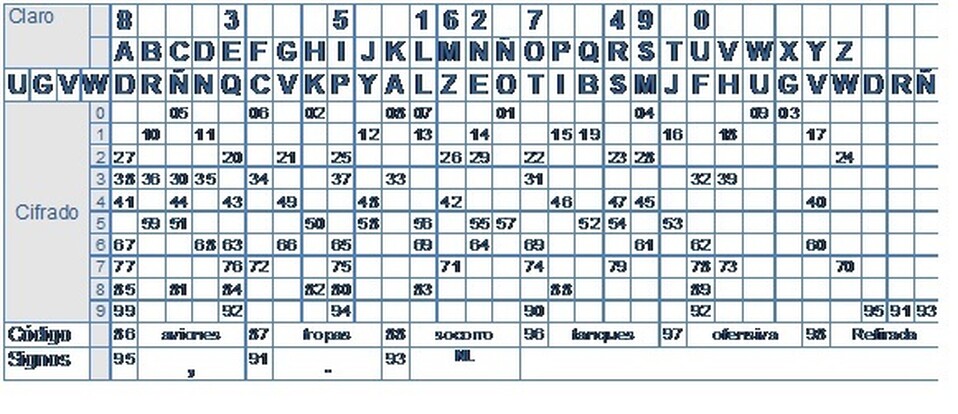
We have covered the upside: a system that allows us to utilize multiple homophone tables via a single master table. Now, let’s look at the downsides. Homophone tables are typically designed to neutralize the frequency characteristics of the original text; however, that is not exactly the case with this specific type of cipher. If we aligned the letter 'W' with the letter 'A' in the example tape system, we would end up with a single symbol—09—representing 'A', which would be cryptographically disastrous. To implement this method correctly, each letter must be assigned between three and five ciphertext symbols. We must avoid assigning the same number of symbols to every letter, as doing so would provide clues to a potential cryptanalyst. The letter pair indicating the tape's alignment can be specified at the beginning of the message—as previously mentioned—or, far better, represented by a pair of numbers indicating that position, placed at a fixed location within the message (e.g., the pairs 10 and 3). These numbers can be derived from the specific letter's column using the fixed alphabet as a reference (for instance, in the example, 'W' aligned with 'A' could be represented by the pairs 09 27 or 09 41, among others). All in all, it is a relatively secure method, provided it is used cautiously and with a moderate volume of traffic.